
KubeCon + CloudNativeCon North America comes to Salt Lake City, November 9–12, and the NGINX team is heading up the mountain with it. Our theme this year is the transition to enterprise-grade Kubernetes, and that now includes AI traffic: inference requests competing for GPUs, and AI agents calling tools over the Model Context Protocol (MCP). Both run through the same layer NGINX has handled for years, the gateway in front of your services.
You’ll find us on the schedule for a panel, a talk, and a live demo, and at booth 100 with lightning talks all week.
Talks to add to your schedule
Monday: DevRel Unfiltered at the Distributed SQL Summit
DevRel Unfiltered: What Developers Actually Build with Agents (and What Breaks)
- When: Monday, November 9, 2:30–3:00 PM MT
- Where: Gallivan Center, Salt Lake City, at the Distributed SQL Summit, a free KubeCon co-located event
- Panelists: Scott McAllister (Community Evangelist, F5), Shivay Lamba (Lead AI/ML Engineer, Qualcomm), Adam Gordon Bell (Community Engineer, Pulumi), and Kat Gaines (Senior Manager, Developer Relations, PagerDuty)
Developer advocates hear what happens when agents reach production, the part demos leave out. In this panel, four DevRel leaders share what developers are really building, which patterns hold up, and where agents fail on context, data, cost, and reliability. Expect honest stories about which approaches are worth trying and which mistakes others have already made for you.
Tuesday: Who’s Governing the GPU Lane? at KyvernoCon
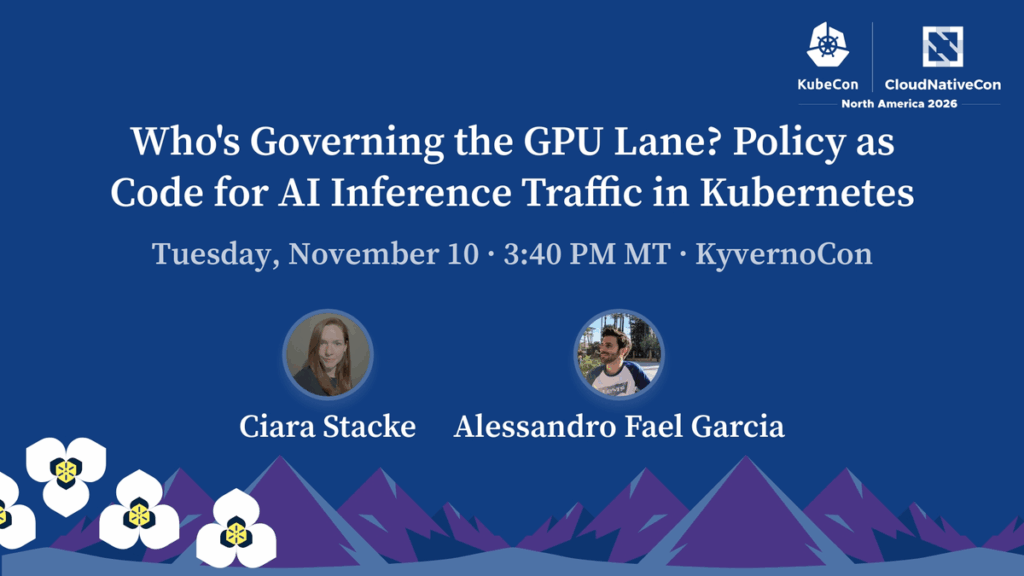
Who’s Governing the GPU Lane? Policy as Code for AI Inference Traffic in Kubernetes
- When: Tuesday, November 10, 3:40–4:05 PM MT
- Where: Salt Palace, Level 1, Halls 1–5, Cosmic Canyon
- Track: KyvernoCon, in the Cloud Native Theater
- Speakers: Ciara Stacke (Tech Lead, NGINX Kubernetes Solutions) and Alessandro Fael Garcia (NGINX Community Evangelist)
Unlike co-located events, KyvernoCon runs inside KubeCon itself, so your KubeCon pass gets you in with no extra registration. It takes place Tuesday afternoon in the Cloud Native Theater, in the Solutions Showcase on the show floor.
Platform teams running AI on Kubernetes face a governance gap that most tooling ignores. GPU-backed models get traffic they shouldn’t, tenant isolation breaks silently, failover bypasses policy, and nobody can say who used which GPU until the bill arrives.
The gap sits in the inference layer: the Gateway API and Inference Extension resources that route AI traffic, decide which models are reachable, and isolate tenants. Ciara and Alessandro show how to close it with Kubernetes-native policy as code. A live demo walks through admission-time patterns that work with any Gateway API implementation and policy engine. You’ll leave with reusable patterns for:
- Tenant isolation guardrails for InferencePool and InferenceObjective resources
- Safe failover and model access controls
- Cost-aware GPU routing
- Defense in depth that pairs admission-time policy with runtime controllers
NGINX Gateway Fabric has supported the Gateway API Inference Extension since 2.2.0. To try it before the talk, see Gateway API Inference Extension in the NGINX Gateway Fabric docs.
Thursday: HTTP 200, Tool Failed, in the Demo Theater
HTTP 200, Tool Failed: Taming MCP Agent Traffic with NGINX
- When: Thursday, November 12, 11:25–11:45 AM MT
- Where: Salt Palace, Level 1, Solutions Showcase, Hall 1, Alpine Overlook Zone, Demo Theater
- Speakers: Micheal Kingston (Product Manager, NGINX on Kubernetes) and Ciara Stacke (Tech Lead, NGINX Kubernetes Solutions)
Users and AI agents now call tools over MCP, and to a gateway every call looks the same: a JSON-RPC POST to /mcp that often returns HTTP 200 even when the tool fails. In this live demo, Micheal and Ciara put NGINX Open Source in front of a set of MCP servers and make tool calls visible and governable with NGINX building blocks you already know: routing, metrics, rate limiting, and authentication.
They follow one tool call end to end, watch NGINX handle it, and explore the metrics in Grafana, including the tool errors hidden inside HTTP 200 responses. To close, they add authentication and per-tool rate limits, tied together in a dashboard that shows the whole flow at a glance.
Visit us at booth 100
Find us at booth 100 on the main show floor of the Salt Palace Convention Center. The booth is built around live demos and time with the engineers who build NGINX:
- The MCP demo, where you can watch NGINX Open Source inspect MCP tool calls in real time, route them to individual backends, catch tool failures disguised as HTTP 200 JSON-RPC responses, and trip per-tool circuit breakers.
- Interactive demo pods with hands-on testbeds for Gateway API migration paths, LLM latency optimization, semantic prompt caching, and multi-cluster ingress policy automation.
- Whiteboard architecture clinics, where you can sit down one on one with F5 principal engineers and work through your Kubernetes bottlenecks, multi-tenancy constraints, or GPU ingress topology.
- Lightning talks in the booth theater, Tuesday to Thursday, from F5 engineers, NGINX maintainers, and partners Red Hat and vCluster.
NGINX maintainers will be at the booth, so bring your questions about NGINX Ingress Controller 5.7.0, NGINX Gateway Fabric 2.8.0, or moving off the retired Ingress-NGINX project.
Lightning talks in the booth theater
Note: This schedule is tentative and might change. Stop by booth 100 for the latest times.
You can drop in without a reservation. All times are Mountain Time.
Tuesday, November 10
| Time (MT) | Talk | Speakers |
|---|---|---|
| 11:00 AM | Ingress API or Gateway API: A decision guide for Kubernetes traffic | Alessandro Fael Garcia |
| 1:00 PM | To Be Announced | To Be Announced |
| 2:00 PM | Ingress-NGINX retirement: The least risky migration path | Jordan Gardner, Micheal Kingston |
| 3:30 PM | Closing the exploit window: Coordinated threat shielding and software remediation with Red Hat Lightwell and F5 | Ramesh Doddaiah (Red Hat), Jordan Gardner |
| 4:20 PM | From network operator to AI cloud: Isolating GPU tenants on NVIDIA DSX OS with vCluster and F5 | Ryan Swanson (vCluster) |
| 6:15 PM | The prompt got past your WAF: A request-path map for AI security on Kubernetes | Scott McAllister |
| 7:00 PM | Deliver and secure AI with NGINX Gateway Fabric | Micheal Kingston |
Wednesday, November 11
| Time (MT) | Talk | Speakers |
|---|---|---|
| 10:40 AM | The state of enterprise Kubernetes strategy 2026 | Marko Sluga, Buu Lam |
| 12:30 PM | Ingress API or Gateway API: A decision guide for Kubernetes traffic | Alessandro Fael Garcia |
| 1:15 PM | To Be Announced | To Be Announced |
| 3:00 PM | From network operator to AI cloud: Isolating GPU tenants on NVIDIA DSX OS with vCluster and F5 | Hrittik Roy (vCluster) |
| 3:50 PM | Deliver and secure AI with NGINX Gateway Fabric | Micheal Kingston |
Thursday, November 12
| Time (MT) | Talk | Speakers |
|---|---|---|
| 10:40 AM | Ingress API or Gateway API: A decision guide for Kubernetes traffic | Alessandro Fael Garcia |
| 12:30 PM | The prompt got past your WAF: A request-path map for AI security on Kubernetes | Scott McAllister |
| 1:15 PM | Ingress-NGINX retirement: The least risky migration path | Jordan Gardner, Micheal Kingston |
Enterprise-grade Kubernetes is the theme this year
Enterprise-grade Kubernetes means running all your clusters as one governed estate. A platform team operates it, with a single owner for security and networking policy and one view of its telemetry.
AI makes getting there more urgent. Platform teams are moving models and agents from experiments into production, serving models on clusters they run themselves and connecting agents to tools over MCP. That traffic needs the same controls as the rest of production: authentication, audit logging, rate limits and token quotas, and inspection of agent tool calls.
Many of those controls belong in the traffic layer, where NGINX sits. That’s where you keep routing and access policy consistent across clusters, trace requests end to end, and rate limit model and agent traffic. NGINX Gateway Fabric supports the Gateway API Inference Extension for model-aware routing, and NGINX Open Source can route MCP tool calls, rate limit them per tool, and trace them with OpenTelemetry.
Our sessions and booth each take on a piece of this transition. The KyvernoCon talk puts AI inference traffic under policy as code, and the MCP demo makes agent tool calls observable before adding authentication and per-tool rate limits. The DevRel panel looks at what breaks when agents reach production.
At the booth, lightning talks cover enterprise Kubernetes strategy, choosing between the Ingress API and Gateway API, migrating off Ingress-NGINX, and securing AI traffic. Red Hat joins us to talk about exploit remediation, and vCluster about GPU tenant isolation. The demo pods include a testbed for multi-cluster ingress policy automation. If you’re working through this on your own platform, bring it to a whiteboard clinic with our engineers.
See you in Salt Lake City
All sessions are in Mountain Time; check the official schedule for any room changes. Can’t make it? Breakout recordings go up on the CNCF YouTube channel after the event, and you can always find the NGINX team on the NGINX Community Forum and at kubernetes.nginx.org.
See you at booth 100!
